Vanadium-51 oxide SDS
V-51 · oxide · Neonest AB / BuyIsotope · 11 pages · English
PDF preview
Open original PDF in a new tab
Product details
Hazard information
See the PDF for complete safety instructions.
Related SDS files
SDS sections
- Identification
- Hazards identification
- Composition / information on ingredients
- First-aid measures
- Fire-fighting measures
- Accidental release measures
- Handling and storage
- Exposure controls / personal protection
- Physical and chemical properties
- Stability and reactivity
- Toxicological information
- Ecological information
- Disposal considerations
- Transport information
- Regulatory information
- Other information
Searchable document text
Text extracted from this exact PDF. Tables, symbols and diagrams may not retain their layout here; the original PDF is authoritative.
PDF page 1 — text transcript
                                                                          Safety Data Sheet for Vanadium Oxide,
                                                                       Enriched Vanadium Oxide
                                                                                         According to ISO 11014:2010

                                                                                                                  First Print Date: 5-Mar-2015
                                                                                               Revision Date: 24-Aug-2019
                                                                                                Version: 1.1.1.


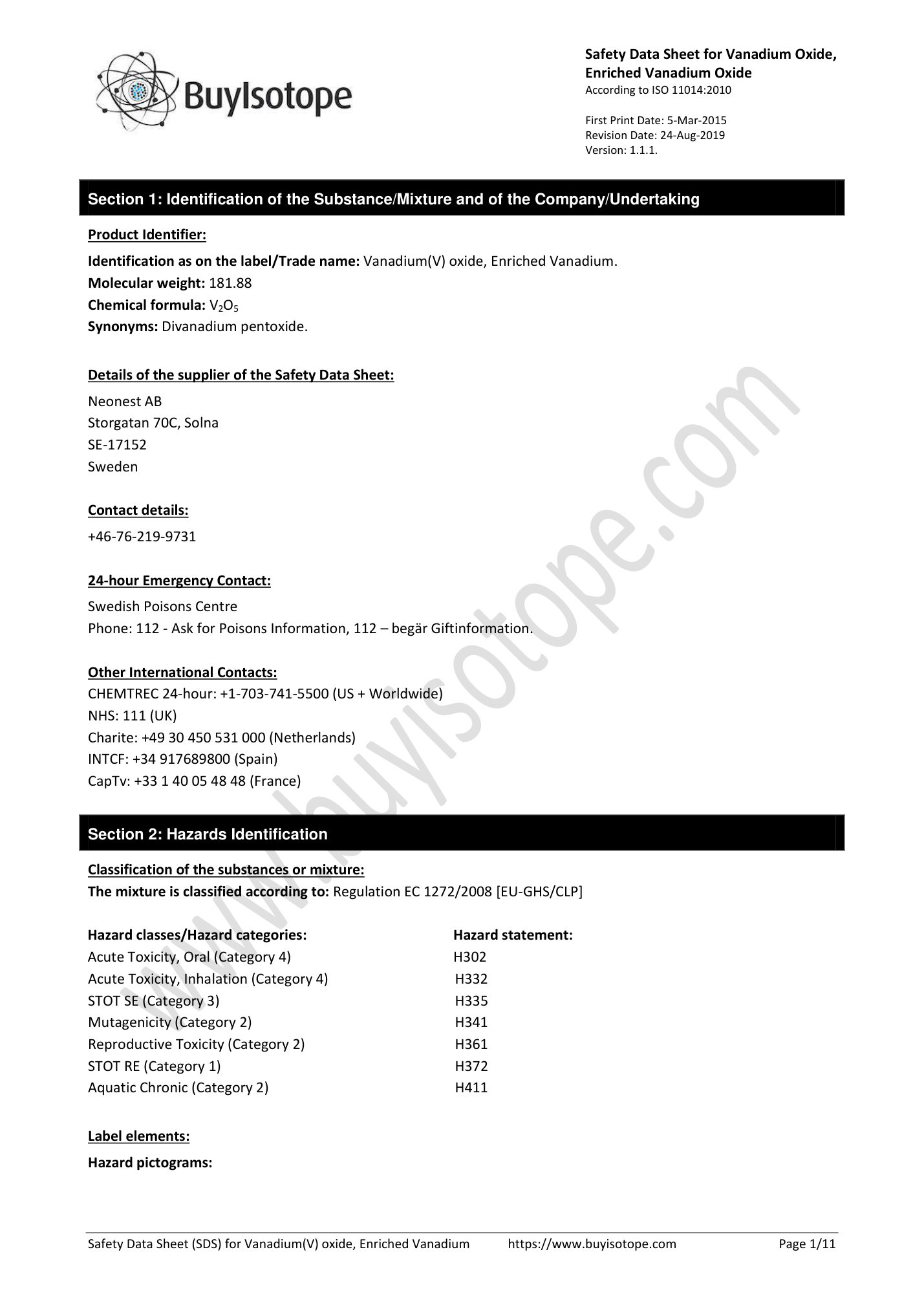
Section 1: Identification of the Substance/Mixture and of the Company/Undertaking

Product Identifier:

Identification as on the label/Trade name: Vanadium(V) oxide, Enriched Vanadium.
Molecular weight: 181.88
Chemical formula: V2O5
Synonyms: Divanadium pentoxide.


Details of the supplier of the Safety Data Sheet:

Neonest AB
Storgatan 70C, Solna
SE-17152
Sweden


Contact details:

+46-76-219-9731


24-hour Emergency Contact:

Swedish Poisons Centre
Phone: 112 - Ask for Poisons Information, 112 – begär Giftinformation.


Other International Contacts:
CHEMTREC 24-hour: +1-703-741-5500 (US + Worldwide)
NHS: 111 (UK)
Charite: +49 30 450 531 000 (Netherlands)
INTCF: +34 917689800 (Spain)
CapTv: +33 1 40 05 48 48 (France)


Section 2: Hazards Identification

Classification of the substances or mixture:
The mixture is classified according to: Regulation EC 1272/2008 [EU-GHS/CLP]


Hazard classes/Hazard categories:                    Hazard statement:
Acute Toxicity, Oral (Category 4)                   H302
Acute Toxicity, Inhalation (Category 4)               H332
STOT SE (Category 3)                            H335
Mutagenicity (Category 2)                        H341
Reproductive Toxicity (Category 2)                  H361
STOT RE (Category 1)                            H372
Aquatic Chronic (Category 2)                      H411


Label elements:

Hazard pictograms:


Safety Data Sheet (SDS) for Vanadium(V) oxide, Enriched Vanadium      https://www.buyisotope.com               Page 1/11
PDF page 2 — text transcript
                                                                          Safety Data Sheet for Vanadium Oxide,
                                                                       Enriched Vanadium Oxide
                                                                                         According to ISO 11014:2010

                                                                                                                  First Print Date: 5-Mar-2015
                                                                                               Revision Date: 24-Aug-2019
                                                                                                Version: 1.1.1.


Signal Words: Danger.
Hazard Statements:
H302 Harmful if swallowed.
H332 Harmful if inhaled.
H335 May cause respiratory irritation.
H341 Suspected of causing genetic defects.
H361 Suspected of damaging fertility or the unborn child.
H372 Causes damage to organs through prolonged or repeated exposure.
H411 Toxic to aquatic life with long lasting effects.


Precautionary Statements:
P201 Obtain special instructions before use.
P202 Do not handle until all safety precautions have been read and understood.
P260 Do not breathe dust.
P270 Do not eat, drink or smoke when using this product.
P271 Use only outdoors or in a well-ventilated area.
P273 Avoid release to the environment.
P280 Wear protective gloves/protective clothing.
P301 + P312 IF SWALLOWED: Call a POISON CENTER/doctor if you feel unwell.
P304 + P340 IF INHALED: Remove person to fresh air and keep comfortable for breathing.
P308 + P313 IF exposed or concerned: Get medical advice/attention.
P391 Collect spillage.
P403 + P233 Store in a well-ventilated place. Keep container tightly closed.
P405 Store locked up.
P501 Dispose of contents/container in accordance with local and national regulations.
Other hazards: None known.


Section 3: Composition/Information on Ingredients

Substance/Mixture: Substance.
Ingredients:


                                   CAS-No.        Molecular      Concentration         Classification
 Substance name (IUPAC/EC)
                                     EC-No.          weight     % by weight        EC1272/2008
                                                                                 Acute Tox. 4    H302
                                                                                 Acute Tox. 4    H332                                   1314-62-1
                                                                         STOT SE 3      H335
 Divanadium pentoxide                                181.88         >99%       Muta. 2 H341   H341
                                                                                        Repr. 2 H361   H361
                                   215-239-8                                  STOT RE 1      H372
                                                                                       Aquatic Chronic 2 H411


Safety Data Sheet (SDS) for Vanadium(V) oxide, Enriched Vanadium      https://www.buyisotope.com               Page 2/11
PDF page 3 — text transcript
                                                                          Safety Data Sheet for Vanadium Oxide,
                                                                       Enriched Vanadium Oxide
                                                                                         According to ISO 11014:2010

                                                                                                                  First Print Date: 5-Mar-2015
                                                                                               Revision Date: 24-Aug-2019
                                                                                                Version: 1.1.1.


For explanation of abbreviations see Section 16.


Section 4: First-Aid Measures

Description of first aid measures:

In case of inhalation: If breathed in, move person into fresh air. If not breathing give artificial respiration Consult a
physician.
In case of skin contact: Wash off with soap and plenty of water. Consult a physician.
In case of eye contact: Rinse thoroughly with plenty of water for at least 15 minutes and consult
a physician.
In case of ingestion: Never give anything by mouth to an unconscious person. Rinse mouth with water. Consult a
physician.


Most important symptoms and effects, both acute and delayed:

Inhalation: Harmful if inhaled; causes respiratory tract irritation.
Eyes: Causes eye irritation.
Skin contact: Causes skin irritation; may be fatal if absorbed through skin.
Ingestion: Harmful if swallowed.
Indication of any immediate medical attention and special treatment needed: Treat symptomatically. Show this
safety data sheet to a physician or emergency room.


Section 5: Fire-Fighting Measures

Extinguisher media:

Suitable extinguisher media: Use water spray, alcohol-resistant foam, dry chemical or carbon dioxide.
Unsuitable extinguishing media: None known.
Special hazards arising from the mixture: None known.
Advice for fire-fighters: Wear self-contained breathing apparatus and protective clothing for firefighting.
Further information: Standard procedure for chemical fires. Use extinguishing measures that are appropriate to local
circumstances and the surrounding environment.


Section 6: Accidental Release Measures

Personal precautions, protective equipment and emergency procedures:

Personal precautions: Use personal protective equipment. Avoid dust formation. Avoid breathing dust. Ensure
adequate ventilation. Evacuate personnel to safe areas.
Environmental precautions: Prevent product from entering drains. Prevent further leakage or spillage if safe to do so.
Local authorities should be advised if significant spillages cannot be contained.


Methods for containment and cleaning up:
Methods for cleaning up: Pick up and arrange disposal without creating dust. Keep in suitable, closed containers for
disposal.


Reference to other sections:
Treat recovered material as described in the section "Disposal considerations".


Safety Data Sheet (SDS) for Vanadium(V) oxide, Enriched Vanadium      https://www.buyisotope.com               Page 3/11
PDF page 4 — text transcript
                                                                          Safety Data Sheet for Vanadium Oxide,
                                                                       Enriched Vanadium Oxide
                                                                                         According to ISO 11014:2010

                                                                                                                  First Print Date: 5-Mar-2015
                                                                                               Revision Date: 24-Aug-2019
                                                                                                Version: 1.1.1.


Section 7: Handling and Storage

Precautions for safe handling:

Advice on safe handling: Avoid formation of dust and aerosols. Provide appropriate exhaust ventilation at places
where dust is formed. Normal measures for preventive fire protection.
Hygiene measures: Do not eat, drink or smoke when using this product.


Conditions for safe storage, including incompatibilities:
Requirements for storage areas and containers: Keep container tightly closed in a dry and well-ventilated place.


Section 8: Exposure Controls/Personal Protection

Control parameters:

Occupational exposure limits:

Components  CAS-No.    Value    Control      Update        Basis
                                 Parameters
Vanadium     1314-62-1  TWA     0.05 mg/m3   2007-01-01   USA - ACGIH
pentoxide                                                      Threshold Limit Values (TLV)
Remarks        Irritation Lung Adopted values or notations enclosed are those for which changes are proposed in the
             NIC See Notice of Intended Changes (NIC) Substances for which there is a Biological Exposure Index or
                Indices (see BEI® section) Not classifiable as a human carcinogen: Agents which cause concern that
              they could be carcinogenic for humans but which cannot be assessed conclusively because of a lack of
               data. In vitro or animal studies do not provide indications of carcinogenicity which are sufficient to
                  classify the agent into one of the other categories.
                  TWA     0.05 mg/m3   1989-01-19   USA - OSHA - TABLE Z-1 Limits for Air
                                                            Contaminants - 1910.1000
                  TWA     0.05 mg/m3   2008-01-01   USA - ACGIH Threshold Limit Values
                                                                    (TLV)
                  Irritation Lung Adopted values or notations enclosed are those for which changes are proposed in the
             NIC See Notice of Intended Changes (NIC) Substances for which there is a Biological Exposure Index or
                Indices (see BEI® section) Not classifiable as a human carcinogen: Agents which cause concern that
              they could be carcinogenic for humans but which cannot be assessed conclusively because of a lack of
               data. In vitro or animal studies do not provide indications of carcinogenicity which are sufficient to
                  classify the agent into one of the other categories.
                      C        0.1 mg/m3    2007-01-01   USA - Occupational Exposure Limits
                                                          (OSHA) - Table Z-1 Limits for Air
                                                            Contaminants
                Ceiling limit is to be determined from breathing-zone air samples.


Exposure controls:

Appropriate engineering controls: A system of local and/or general exhaust is recommended to keep employee
exposures below the Airborne Exposure Limits. Local exhaust ventilation is generally preferred because it can control
the emissions of the contaminant at its source, preventing dispersion into the general work area.


Individual protection measures, such as personal protective equipment:


Safety Data Sheet (SDS) for Vanadium(V) oxide, Enriched Vanadium      https://www.buyisotope.com               Page 4/11
PDF page 5 — text transcript
                                                                          Safety Data Sheet for Vanadium Oxide,
                                                                       Enriched Vanadium Oxide
                                                                                         According to ISO 11014:2010

                                                                                                                  First Print Date: 5-Mar-2015
                                                                                               Revision Date: 24-Aug-2019
                                                                                                Version: 1.1.1.


Eye/face protection: Face shield and safety glasses.
Hand protection: Use chemical resistant gloves. Examples of preferred glove barrier materials include: Butyl rubber,
Neoprene, Nitrile/butadiene rubber, Polyethylene, Ethyl vinyl alcohol laminate, polyvinyl alcohol, Polyvinyl chloride.
Body protection: Choose body protection according to the amount and concentration of the dangerous substance at
the work place.
Respiratory protection: Where risk assessment shows air-purifying respirators are appropriate use a full-face particle
respirator type N100 (US) or type P3 (EN 143) respirator cartridges as a backup to engineering controls.  If the
respirator is the sole means of protection, use a full-face supplied air respirator. Use respirators and components
tested and approved under appropriate government standards such as NIOSH (US) or CEN (EU).


Section 9: Physical and Chemical Properties

Information on basic physical and chemical properties

Appearance (form): Solid.
Colour: No data available.
Odour: No data available.
Odour threshold: No data available.
Molecular Weight: 181.88
pH (concentration): No data available.
Melting point/range (°C): 690 °C
Boiling point/range (°C): No data available.
Freezing point (°C): No data available.
Flash point (°C): No data available.
Evaporation rate: No data available.
Flammability (solid, gas): No data available.
Ignition temperature (°C): No data available.
Upper/lower flammability/explosive limits: No data available.
Vapour pressure (20 °C): No data available.
Vapour density: No data available.
Relative density (25 °C): 3.35 g/mL at 25 °C
Water solubility (g/L) at 20 °C: No data available.
n-Octanol/Water partition coefficient: No data available.
Auto-ignition temperature: No data available.
Decomposition temperature: No data available.
Viscosity, dynamic (mPa s): No data available.
Explosive properties: The substance or mixture is not classified as explosive.
Oxidising properties: The substance or mixture is not classified as oxidizing.


Section 10: Stability and Reactivity

Reactivity: No dangerous reaction known under conditions of normal use.
Chemical stability: Stable under normal conditions.
Possibility of hazardous reactions: No dangerous reaction known under conditions of normal use.
Conditions to avoid: None known.
Incompatible materials: Strong acids.
Hazardous  decomposition  products:  Hazardous  decomposition  products  formed  under   fire  conditions:
vanadium/vanadium oxides.


Safety Data Sheet (SDS) for Vanadium(V) oxide, Enriched Vanadium      https://www.buyisotope.com               Page 5/11
PDF page 6 — text transcript
                                                                          Safety Data Sheet for Vanadium Oxide,
                                                                       Enriched Vanadium Oxide
                                                                                         According to ISO 11014:2010

                                                                                                                  First Print Date: 5-Mar-2015
                                                                                               Revision Date: 24-Aug-2019
                                                                                                Version: 1.1.1.


Section 11: Toxicological Information

Information on toxicological effects:

Acute Toxicity:
LD50 Oral (rat) 10 mg/kg.
Remarks: Behavioural: Coma.
LC50 Inhalation (rat) 6 h - 126 mg/m3
Remarks: Sense Organs and Special Senses (Nose, Eye, Ear, and Taste): Eye: Other. Behavioural: Ataxia. Lungs, Thorax,
or Respiration: Dyspnoea.
LD50 Dermal (rabbit) 50 mg/kg
Remarks: Liver: Other changes. Kidney, Ureter, Bladder: Other changes.

Classification according to GHS (1272/2008/EG, CLP)
Skin corrosion/irritation:
Not classified based on available information.
Serious eye damage/eye irritation:
Not classified based on available information.
Respiratory or skin sensitisation:
May cause respiratory irritation.
Germ cell mutagenicity:
Laboratory experiments have shown mutagenic effects. In vitro tests showed mutagenic effects.
Carcinogenicity:
IARC: 2B - Group 2B: Possibly carcinogenic to humans (Vanadium pentoxide) ACGIH No component of this product
present at levels greater than or equal to 0.1% is identified as a carcinogen or potential carcinogen by ACGIH.
NTP: No component of this product present at levels greater than or equal to 0.1% is identified as a known or
anticipated carcinogen by NTP.
OSHA: No component of this product present at levels greater than or equal to 0.1% is identified as a carcinogen or
potential carcinogen by OSHA.
Reproductive toxicity:
Possible risk of congenital malformation in the foetus. Suspected human reproductive toxicant.
Specific target organ toxicity – single exposure (STOT):
Not classified based on available information.
Specific target organ toxicity (STOT) – repeated exposure:
Causes damage to organs through prolonged or repeated exposure.
Aspiration toxicity:
Not classified based on available information.


Section 12: Ecological Information

Toxicity: Toxic to aquatic life with long lasting effects.
Toxicity to fish: LC50 - Oncorhynchus mykiss (rainbow trout) - 5.2 mg/l - 96.0 h
Toxicity to Daphnia and Other Aquatic Invertebrates: EC50 - Daphnia magna (Water flea) - 0.94 mg/l - 48 h
Persistence and degradability: No data available.
Bioaccumulative potential: No data available.
Mobility in soil: No data available.
Results of PBT& vPvB assessment: Not relevant.


Safety Data Sheet (SDS) for Vanadium(V) oxide, Enriched Vanadium      https://www.buyisotope.com               Page 6/11
PDF page 7 — text transcript
                                                                          Safety Data Sheet for Vanadium Oxide,
                                                                       Enriched Vanadium Oxide
                                                                                         According to ISO 11014:2010

                                                                                                                  First Print Date: 5-Mar-2015
                                                                                               Revision Date: 24-Aug-2019
                                                                                                Version: 1.1.1.


Other adverse effects: An environmental hazard cannot be excluded in the event of unprofessional handling or
disposal.


Section 13: Disposal Considerations

Waste treatment methods: Observe all local and national environmental regulations. Contact a licensed professional
waste disposal service to dispose of this material. Dissolve or mix the material with a combustible solvent and burn in
a chemical incinerator equipped with an afterburner and scrubber.


Section 14: Transport Information

DOT:

Proper Shipping Name: VANADIUM PENTOXIDE.
Hazard Class: 6.1
UN Number: 2862
Packing Group: III
Hazard Labels:


Reportable quantity: 1000 lbs
Marine Pollutant: No


IMDG:

Proper Shipping Name: VANADIUM PENTOXIDE.
Hazard Class: 6.1
UN Number: 2862
Packing Group: III
EMS No.: F-A, S-A
Marine Pollutant: No


IATA:

Proper Shipping Name: VANADIUM PENTOXIDE.
Hazard Class: 6.1
UN Number: 2862
Packing Group: III


Section 15: Regulatory Information

EU regulations:

Regulation (EC) No. 1005/2009 on substances that deplete the ozone layer, Annex I and II, as amended
Not listed.
Regulation (EC) No. 850/2004 on persistent organic pollutants, Annex I
Not listed.


Safety Data Sheet (SDS) for Vanadium(V) oxide, Enriched Vanadium      https://www.buyisotope.com               Page 7/11
PDF page 8 — text transcript
                                                                          Safety Data Sheet for Vanadium Oxide,
                                                                       Enriched Vanadium Oxide
                                                                                         According to ISO 11014:2010

                                                                                                                  First Print Date: 5-Mar-2015
                                                                                               Revision Date: 24-Aug-2019
                                                                                                Version: 1.1.1.


Regulation (EU) No. 649/2012 concerning the export and import of dangerous chemicals, Annex  I, Part 1 as
amended
Not listed.
Regulation (EU) No. 649/2012 concerning the export and import of dangerous chemicals, Annex  I, Part 2 as
amended
Not listed.
Regulation (EU) No. 649/2012 concerning the export and import of dangerous chemicals, Annex  I, Part 3 as
amended
Not listed.
Regulation (EU) No. 649/2012 concerning the export and import of dangerous chemicals, Annex V as amended
Not listed.
Regulation (EC) No. 166/2006 Annex II Pollutant Release and Transfer Registry
Not listed.
Regulation (EC) No. 1907/2006, REACH Article 59(10) Candidate List as currently published by ECHA
Not listed.


Authorisations:
Regulation (EC) No. 1907/2006, REACH Annex XIV Substances subject to authorization, as amended
Not listed.


Restrictions on use:
Regulation (EC) No. 1907/2006 Annex XVII Substances subject to restriction on marketing and use
Not regulated.
Regulation (EC) No. 1907/2006, REACH Annex XVII Substances subject to restriction on marketing and use as
amended
Not listed.
Directive 2004/37/EC on the protection of workers from the risks related to exposure to carcinogens and mutagens
at work
Not regulated.
Directive 92/85/EEC: on the safety and health of pregnant workers and workers who have recently given birth or
are breastfeeding.
Not regulated.


Other EU regulations:
Directive 2012/18/EU on major accident hazards involving dangerous substances
Not listed.
Directive 98/24/EC on the protection of the health and safety of workers from the risks related to chemical agents
at work.
Always applicable.
Directive 94/33/EC on the protection of young people at work
Not listed.


Other regulations: The product is classified and labelled in accordance with EC directives or respective national laws.
This Safety Data Sheet complies with the requirements of Regulation (EC) No 1907/2006, as amended.
OSHA Hazards: Target Organ Effect, Highly toxic by inhalation, Highly toxic by ingestion, Highly toxic by skin
absorption, Irritant, Carcinogen, Teratogen.
DSL Status: All components of this product are on the Canadian DSL list.


Safety Data Sheet (SDS) for Vanadium(V) oxide, Enriched Vanadium      https://www.buyisotope.com               Page 8/11
PDF page 9 — text transcript
                                                                          Safety Data Sheet for Vanadium Oxide,
                                                                       Enriched Vanadium Oxide
                                                                                         According to ISO 11014:2010

                                                                                                                  First Print Date: 5-Mar-2015
                                                                                               Revision Date: 24-Aug-2019
                                                                                                Version: 1.1.1.


SARA 302 Components: Vanadium pentoxide / CAS No. 1314-62-1 / Revision Date 2007-07-01
SARA 313 Components: Vanadium pentoxide / CAS No. 1314-62-1 / Revision Date 2007-07-01
SARA 311/312 Hazards: Acute Health Hazard, Chronic Health Hazard.
Massachusetts Right To Know Components: Vanadium pentoxide / CAS No. 1314-62-1 / Revision Date 2007-07-01
Pennsylvania Right To Know Components: Vanadium pentoxide / CAS No. 1314-62-1 / Revision Date 2007-07-01
New Jersey Right To Know Components: Vanadium pentoxide / CAS No. 1314-62-1 / Revision Date 2007-07-01
California Prop. 65 Components: This product does not contain any chemicals known to the State of California to
cause cancer, birth defects, or any other reproductive harm.
National regulations: Follow national regulation for work with chemical agents.
Chemical safety assessment: No Chemical Safety Assessment has been carried out.


Section 16: Other Information

List of abbreviations:
ACGIH American Conference of Governmental Industrial Hygienists
ADR European Agreement Concerning the International Carriage of Dangerous Goods by Road
ALARA As Low As Is Reasonably Achievable
AMU Atomic Mass Unit
ANSI American National Standards Institute
BLS Basic Life Support
CAM Continuous Air Monitor
CAS Chemical Abstracts Service (division of the American Chemical Society)
CEN European Committee for Standardization
CERCLA Comprehensive Environmental Response Compensation and Liability Act
CLP Classification, Labelling and Packaging (European Union)
CPR Controlled Products Regulations (Canada)
CWA Clean Water Act (USA)
DAC Derived Air Concentration (USA)
DOE United States Department of Energy (USA)
DOT United States Department of Transportation (USA)
DSL Domestic Substances List (Canada)
EC50 Half Maximal Effective Concentration
EINECS European Inventory of Existing Commercial Chemical Substances
EHS Environmentally Hazardous Substance
ELINCS European List of Notified Chemical Substances
EMS Emergency Response Procedures for Ships Carrying Dangerous Goods
EPA Environmental Protection Agency (USA)
EPCRA Emergency Planning and Community Right-To-Know Act (EPCRA) of 1986
GHS Globally Harmonized System
HMIS Hazardous Materials Identification System (USA)
IARC International Agency for Research on Cancer
IATA International Air Transport Association
IBC Intermediate Bulk Containers
ICAO International Civil Aviation Organization
IDLH Immediately Dangerous to Life or Health
IMDG International Maritime Code for Dangerous Goods
LC50 Lethal concentration, 50 percent


Safety Data Sheet (SDS) for Vanadium(V) oxide, Enriched Vanadium      https://www.buyisotope.com               Page 9/11
PDF page 10 — text transcript
                                                                          Safety Data Sheet for Vanadium Oxide,
                                                                       Enriched Vanadium Oxide
                                                                                         According to ISO 11014:2010

                                                                                                                  First Print Date: 5-Mar-2015
                                                                                               Revision Date: 24-Aug-2019
                                                                                                Version: 1.1.1.


LD50 Lethal dose, 50 percent
LDLO Lethal Dose Low
LOEC Lowest-Observed-Effective Concentration
MARPOL International Convention for the Prevention of Pollution from Ships
MSHA Mine Safety and Health Administration (USA)
NCRP National Council on Radiation Protection & Measurements (USA)
NDSL Non-Domestic Substances List (Canada)
NFPA National Fire Protection Association (USA)
NIOSH National Institute for Occupational Safety and Health (USA)
NOEC No Observed Effect Concentration
N.O.S. Not Otherwise Specified
NRC Nuclear Regulatory Commission (USA)
NTP National Toxicology Program (USA)
OSHA Occupational Safety and Health Administration (USA)
PBT Persistent Bioaccumulative and Toxic Chemical
PEL Permissible Exposure Limit
PIH Poisonous by Inhalation Hazard
RCRA Resource Conservation and Recovery Act (USA)
RCT Radiation Control Technician
REACH Registration, Evaluation, Authorisation and Restriction of Chemicals (Europe)
RID Regulations Concerning the International Transport of Dangerous Goods by Rail
RTECS Registry of Toxic Effects of Chemical Substances
SARA Superfund Amendments and Reauthorization Act (USA)
TDG Transportation of Dangerous Goods (Canada)
TIH Toxic by Inhalation Hazard
TLV Threshold Limit Value
TPQ Threshold Planning Quantity
TSCA Toxic Substances Control Act
TWA Time Weighted Average
UN United Nations (Number)
VOC Volatile Organic Compound
vPvB Very Persistent Very Bioaccumulative Chemical
WGK Wassergefährdungsklassen (Germany: Water Hazard Classes)
WHMIS Workplace Hazardous Materials Information System
References:
Not available.
Full text of any H-statements not written out in full under Sections 2 to 15:
H302 Harmful if swallowed.
H332 Harmful if inhaled.
H335 May cause respiratory irritation.
H341 Suspected of causing genetic defects.
H361 Suspected of damaging fertility or the unborn child.
H372 Causes damage to organs through prolonged or repeated exposure.
H411 Toxic to aquatic life with long lasting effects.
Revision information:
None.
Training information:


Safety Data Sheet (SDS) for Vanadium(V) oxide, Enriched Vanadium      https://www.buyisotope.com              Page 10/11
PDF page 11 — text transcript
                                                                          Safety Data Sheet for Vanadium Oxide,
                                                                       Enriched Vanadium Oxide
                                                                                         According to ISO 11014:2010

                                                                                                                  First Print Date: 5-Mar-2015
                                                                                               Revision Date: 24-Aug-2019
                                                                                                Version: 1.1.1.


Follow training instructions when handling this material.
Further Information:
The information provided in this Safety Data Sheet is correct to the best of our knowledge, information and belief at
the date of its publication. The information given is designed only as a guidance for safe handling, use, processing,
storage, transportation, disposal and release and is not to be considered a warranty or quality specification. The
information relates only to the specific material designated and may not be valid for such material used in
combination with any other materials or in any process, unless specified in the text.


Safety Data Sheet (SDS) for Vanadium(V) oxide, Enriched Vanadium      https://www.buyisotope.com              Page 11/11
Document notes & file formats
Document scope
The supplier associates this chemical form with an element-family SDS. The PDF does not establish applicability to a particular isotope enrichment or batch. Supplier revision: 2019-08-24. Confirm the current revision and product applicability with the supplier.
PDF & Word
The PDF is the original supplier document. Word is a converted page-image copy that preserves the PDF layout; it is not an editable-text or supplier-issued Word original.
Document details are transcribed from this PDF and are not a batch specification.
File verification
These dates record site checks, not the supplier revision.
SHA-256: 77a62d59a5fc1db4c5c9489cefff6467cd1d927536903fd16f81c8ef3da1c93b